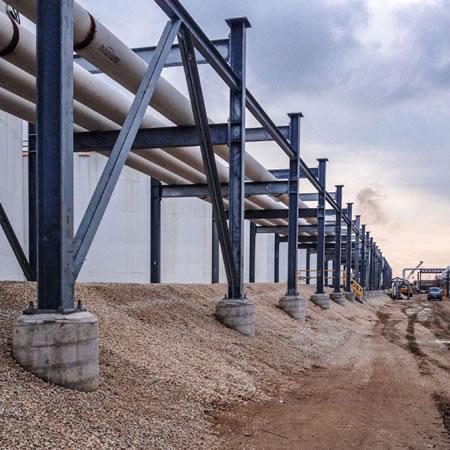
Pipe Rack Foundation Design for Industrial Projects
A pipe rack foundation is an important part of an industrial facility. Pipe racks are structural systems used to support process pipes, electrical cable trays, instrument trays, and sometimes other industrial equipment. They are commonly found in refineries, chemical plants, power plants, manufacturing facilities, and other large industrial projects.
The foundation provides stable support to the steel or concrete pipe rack structure and transfers the loads safely to the ground. A properly designed pipe rack foundation is therefore essential for the safety, stability, and long-term performance of the industrial structure.
What is a Pipe Rack?
A pipe rack is generally a steel or reinforced concrete structural frame that carries pipes and utility services at different levels. Instead of placing industrial pipelines directly on the ground, pipe racks raise them above the operating area and provide an organized route through the plant.
A typical pipe rack may support process pipelines, utility lines, electrical cable trays, instrumentation trays, and other services. The arrangement and spacing of the rack depend on the requirements of the industrial facility and the size and number of pipelines.
Because these structures can carry significant loads at considerable heights, pipe rack structural design requires careful engineering and coordination between civil, structural, piping, electrical, and other engineering disciplines.
Importance of Pipe Rack Foundation Design
The main purpose of a foundation is to safely transfer the loads from the pipe rack columns to the soil.
During foundation design, engineers consider vertical loads from the structure and supported services, as well as horizontal forces, wind effects, seismic forces, and overturning moments. The actual design loads depend on the specific industrial project.
The foundation must also work safely with the soil below it. This is why a geotechnical investigation is an important input for industrial foundation design. Soil bearing capacity, groundwater conditions, settlement characteristics, and other site conditions can influence the type and size of foundation required.
Types of Pipe Rack Foundations
The foundation type depends on the structural loads and site soil conditions. Common solutions include isolated spread footings, pile caps, combined foundations, and foundations connected with grade beams where required.
For sites with suitable soil conditions and moderate loads, individual foundations below pipe rack columns may be practical. Where soil conditions are weak or the structure produces high uplift or lateral forces, a pile foundation system may be considered.
The final civil engineering foundation design should always be based on project-specific structural calculations and geotechnical information rather than using a standard foundation size for every project.
Structural Loads on Pipe Rack Foundations
A pipe rack foundation does not only carry the weight of the steel structure. It may also receive loads from the pipes, cable trays, insulation, platforms, equipment, and other supported services.
Engineers may also need to consider wind load, seismic load, piping loads, thermal effects, horizontal forces, and overturning moments. These loads are transferred through the pipe rack columns to the foundations.
This makes structural analysis and design an important part of the overall pipe rack engineering process.
Concrete Foundation and Anchor Bolts
In a typical steel pipe rack, the steel columns are connected to concrete foundations using base plates and anchor bolts. These connections transfer forces between the steel structure and the concrete foundation.
Proper positioning of anchor bolts is important during construction because the steel columns must be installed accurately on the foundation. The foundation may also include a concrete pedestal above the footing to provide the required column connection level.
The construction process generally includes activities such as setting out, excavation, lean concrete, reinforcement placement, formwork, anchor bolt installation, concrete pouring, curing, grouting, and backfilling.
Pipe Rack Foundation Construction
Good construction practices are important for achieving the required quality of an industrial foundation. Before concrete work begins, the foundation location and levels should be checked carefully.
Reinforcement should be placed according to the approved structural drawings, and anchor bolts should be accurately positioned. Concrete should be properly placed and compacted, followed by appropriate curing and finishing.
After the foundation reaches the required condition, steel pipe rack columns can be erected and connected to the foundations.
Why Professional Pipe Rack Engineering Matters
A pipe rack is an important part of an industrial facility because it connects different plant areas and carries essential services. Any problem in the structural system or its foundation can affect plant operations.
Professional pipe rack design and engineering therefore requires coordination between structural requirements, piping layouts, foundation conditions, construction requirements, and the overall plant layout.
At Onridge, our approach to civil and structural engineering focuses on developing practical solutions for industrial structures. From pipe rack structural systems and foundation design to engineering drawings and construction coordination, each part of the project needs to be properly planned and checked.
Conclusion
A well-designed pipe rack foundation provides the stable base required for an industrial pipe rack system. The design needs to consider structural loads, soil conditions, wind and seismic effects, foundation stability, anchor connections, and construction requirements.
With proper structural engineering, civil engineering, foundation design, and construction planning, pipe rack systems can provide safe and organized support for pipelines and other industrial services.
For industrial projects, Onridge focuses on practical engineering solutions that support safe, efficient, and reliable industrial structure design and foundation engineering.