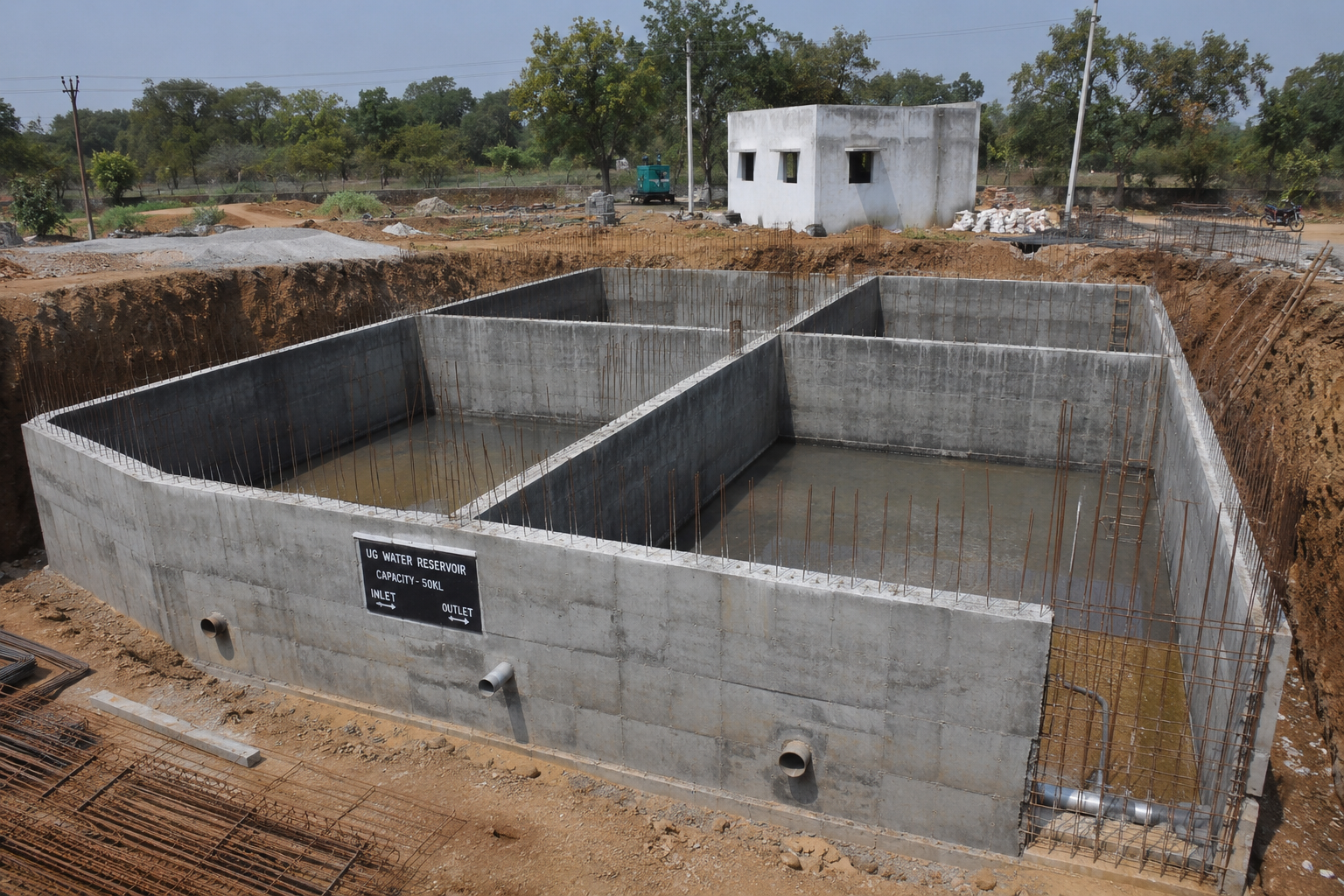
Water Retaining Structure Design for Civil Engineering Projects
A water retaining structure is a civil engineering structure designed to safely store, contain, or control water. These structures are used in many residential, commercial, industrial, and infrastructure projects where water needs to be stored or managed safely.
Common examples include water tanks, underground water reservoirs, RCC water tanks, water treatment tanks, sumps, swimming pools, and other reinforced concrete water-retaining structures.
The main purpose of a water retaining structure is to hold water without leakage while safely resisting the pressure created by the stored water. Proper structural design and civil engineering are therefore important for the strength, durability, and long-term performance of the structure.
What is a Water Retaining Structure?
A water retaining structure is generally constructed using reinforced cement concrete (RCC) or other suitable structural materials. The structure may be located above ground, partially below ground, or completely underground depending on the project requirements.
Unlike many conventional structures, water-retaining structures need special attention to waterproofing, crack control, durability, and leakage prevention.
The design needs to consider the size and capacity of the tank, water pressure, soil conditions, groundwater conditions, environmental exposure, and other project-specific requirements.
Types of Water Retaining Structures
Different types of water-retaining structures are used depending on their purpose and location.
Common examples include RCC water tanks, underground water tanks, water reservoirs, sump tanks, treatment tanks, balancing tanks, and process water tanks.
An overhead water tank may be supported on columns or a structural staging system, while an underground reservoir is surrounded by soil and may also experience external groundwater pressure.
The selection of the appropriate structure depends on factors such as storage capacity, available space, soil conditions, water requirements, and the overall project design.
Importance of Water Retaining Structure Design
Proper water retaining structure design is essential because the structure must safely contain water without excessive deformation, cracking, or leakage.
When water is stored inside a tank or reservoir, it creates pressure on the walls and base slab. For underground structures, external soil and groundwater can also create pressure on the structure.
Engineers evaluate these conditions during structural analysis and design to determine suitable wall thickness, slab thickness, reinforcement, foundation arrangement, and other structural requirements.
RCC Water Tank Design
RCC water tank design is commonly used for water storage because reinforced concrete provides the required structural strength and durability when properly designed and constructed.
The design of an RCC tank generally includes the analysis of the base slab, side walls, roof slab where applicable, columns or supports, and foundation system.
Reinforcement is carefully arranged to resist structural forces and help control cracking. The design also considers the requirements associated with water tightness and durability.
Water Pressure and Structural Loads
Water creates hydrostatic pressure on the walls and base of a water-retaining structure. The pressure increases with the depth of water, so the lower portions of the tank walls can experience greater pressure.
Engineers also consider other loads depending on the structure. These may include self-weight, soil pressure, groundwater pressure, live loads, roof loads, seismic effects, and other project-specific forces.
Understanding these loads is an important part of structural engineering design because the structure must remain stable and safe under the expected loading conditions.
Crack Control and Water Tightness
One of the most important requirements of a water-retaining structure is controlling cracks and preventing water leakage.
Even small cracks can become a concern when the structure is required to remain water-tight. Therefore, crack control in RCC structures is an important part of the design and detailing process.
Engineers consider reinforcement arrangement, concrete quality, construction joints, expansion joints where required, curing, and other detailing requirements to improve the performance of the structure.
Proper construction practices are equally important because good structural design alone cannot guarantee water tightness if the construction quality is poor.
Waterproofing of Water Retaining Structures
Waterproofing can provide additional protection against leakage and moisture movement. The waterproofing system depends on whether the structure is above ground or underground and on the specific project requirements.
For underground water tanks and reservoirs, waterproofing may be required on external surfaces, internal surfaces, joints, or other vulnerable areas.
Construction joints and pipe penetrations require particular attention because these locations can become potential leakage points if they are not properly detailed and executed.
Foundation Design for Water Retaining Structures
The foundation provides support to the water-retaining structure and transfers the structural loads safely to the soil.
Foundation design depends on factors such as soil bearing capacity, groundwater level, tank dimensions, water storage capacity, structural loads, and settlement conditions.
For underground structures, engineers may also need to consider uplift pressure caused by groundwater when the tank is empty. The foundation and overall structure must be checked for stability against possible uplift.
A proper geotechnical investigation provides important information about the soil and groundwater conditions before the foundation system is finalized.
Construction of Water Retaining Structures
Construction quality plays an important role in the performance of a water-retaining structure.
The construction process generally includes excavation where required, foundation preparation, reinforcement installation, formwork, concrete placement, curing, joint treatment, waterproofing, and testing.
The correct placement of reinforcement, proper concrete compaction, adequate curing, and careful treatment of construction joints can help reduce the risk of cracks and leakage.
Before the structure is put into regular service, suitable water-tightness testing may be carried out according to the project requirements.
Industrial Applications of Water Retaining Structures
Water-retaining structures are widely used in industrial and infrastructure projects. Industries may require water storage for process operations, fire protection, cooling systems, water treatment, or general plant requirements.
In industrial projects, water tanks and reservoirs may need to be coordinated with other civil and structural systems, pipelines, pumps, drainage systems, and mechanical equipment.
This makes proper industrial civil engineering design and multidisciplinary coordination important during project development.
Why Professional Water Retaining Structure Design Matters
A water-retaining structure needs more than simply a strong concrete wall. It requires careful consideration of structural strength, water pressure, soil conditions, crack control, durability, waterproofing, joints, and construction quality.
Professional civil engineering and structural design can help ensure that the structure is suitable for its intended use and site conditions.
At Onridge, our approach to civil and structural engineering focuses on practical solutions for water-retaining and industrial structures. From RCC structural design and foundation engineering to structural detailing and construction coordination, every part of the project is considered to support a safe and durable structure.
Conclusion
A properly designed water retaining structure provides a safe and reliable solution for storing and managing water in residential, commercial, industrial, and infrastructure projects.
From RCC water tank design and foundation design to crack control, waterproofing, structural analysis, and construction planning, every stage plays an important role in the performance of the structure.
With proper civil engineering, structural engineering, material selection, detailing, and construction practices, water-retaining structures can provide long-term service while reducing the risk of leakage, cracking, and structural problems.
At Onridge, we focus on practical engineering solutions for water-retaining structures, RCC structures, industrial civil engineering, structural design, and foundation engineering, helping develop safe, durable, and buildable solutions for different project requirements.